Affichage des articles dont le libellé est Sangkhalok. Afficher tous les articles

lundi 5 août 2013

Les fours de Sawankhalok à Ban Pa Yang / Sawankhalok kilns, Ban Pa Yang kiln site

Le site des fours de "Ban Pa Yang" est situé le long de la rivère Yom, à cinq kilomètres au nord de l'ancienne ville de Si Satchanalai, actuellement inscrite au patrimoine mondial de l'UNESCO. Ce groupe de fours a une forme en "goutte d'eau". Le four dit four Thuriang, comprenait trois parties, l'alandier devant, la chambre où sont placés les poteries et la cheminée au bout du four. La température de cuisson pouvait atteindre 1250° à 1300° celsius pour produire des poteries de grès, haute température.

La période florissante des grès de Sawankhalok, ou Sangkhalok a duré 200 à 250 ans ans, entre le 14éme et le 16 ème siècle.
Ces poteries étaient populaires, non seulement en Thaïlande, mais aussi dans l'Asie du sud est et au Japon.
Beaucoup de pièces ont été retrouvées dans des navires naufragés dans le golfe de Thaïlande, mais aussi sur des sites archéologiques dans d'autres pays, comme l'Indonésie, les Philippines et le Japon.

The kilns of "Ban Pa Yang" are located along the Yom River, five kilometers north of the ancient city of Si Satchanalai currently listed as World Heritage by UNESCO. This group of kilns are crossdraft and have a water-dropped shape. The Thuriang kiln had three parts, the firebox,  the chamber pottery and the chimney at the rear of the kiln. The firing temperature can reach 1250 ° to 1300 ° Celsius to produce stoneware pottery.

The flourishing period of Sawankhalok or Sangkhalok ware lasted 200 to 250 years years, between the 14th and 16th century.
These pots were popular not only in Thailand but also in Southeast Asia and Japan.
Many pieces have been found in shipwrecks in the Gulf of Thailand, but also on archaeological sites in other countries, such as Indonesia, the Philippines and Japan.

The perspective is distorted
 Malgré la distorsion de la perspective l'on peut voir la façon dont la forme est construite entre la chambre et la cheminée, probablement pour améliorer le tirage.

Despite the distortion of perspective we can see how the shape is built between the chamber and the chimney, probably to improve the draw.

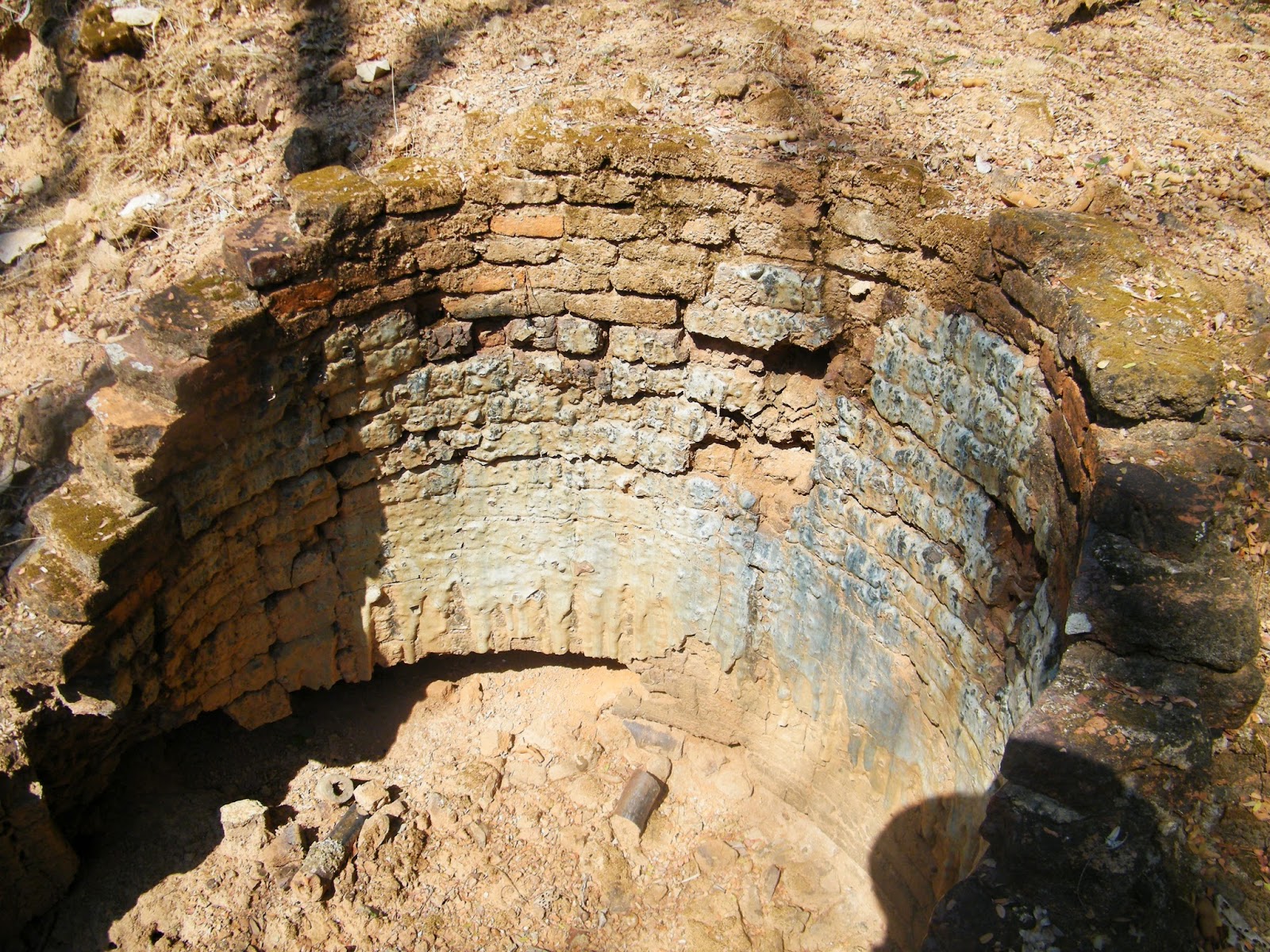
Blue glaze in the chimney


Sur tous les fours, à l'extérieur, l'alandier est enterré et n'est plus visible, mais on peut voir le mur qui sépare l'alandier de la chambre plus en hauteur, à l'intérieur du four et l'on peut voir également l'émail bleu qui recouvre les parois de la cheminée.

On all the kilns, outside, the firebox is buried and is no longer visible, but you can see the wall that separates the firebox from the chamber higher up in the kiln and you can also see the blue glaze that covers the walls of the chimney.
Close up to the blue glaze

 A l'intérieur de certains fours, la cheminée est construite avec des quilles d'enfournement.

Inside some kilns, the chimney is built of loading keels.


Ban Ko Noi kiln
 Le site de Ban Ko Noi fera l'objet d'un autre article.
 Vous pouvez aussi voir les lien suivant : http://armelleleon.blogspot.fr/2013/02/sawankhalok-si-satchalanai-chaliang.html

I will speak about Ban Ko Noi site another post.
You can also see the following link: http://armelleleon.blogspot.fr/2013/02/sawankhalok-si-satchalanai-chaliang.html

samedi 9 février 2013

Sawankhalok, Si Satchanalai, Chaliang, Sukhotai, Thaïlande, part 3


Wat Khao Suwan Kiri

Tessons de céramiques de Sawankhalok, Wat Chom Cheun excavation pit, Chaliang.
Pour ceux d'entre vous qui souhaiteraient poussez plus loin, l'étude des céramiques dites de Sawankhalok, Swankhalok ou Sangkhalok, voici un lien très intéressant, c'est un article écrit par le Dr Iwan Suwandy à propos des céramiques de Sawankhalok trouvées dans l'épave du  Thuriang, navire échoué à l'est de la Malaisie dans la partie méridionale de la mer de Chine vers 1305-1370.

For those of you who wish to push further the study of ceramics say Sawankhalok, or Swankhalok or  Sangkhalok, here is a very interesting link is an article written by Dr. Iwan Suwandy about Sawankhalok ceramics found in the wreck of Thuriang, vessel aground east of Malaysia in the southern part of the South China Sea in 1305-1370.

Passerelle sur la Yom

 Pour arriver sur le site de Si Satchanalai, l'on peut emprunter la passerelle, le premier temple que l'on voit, Wat Phara Si Rattana Mahathat, Chaliang, est très impressionnant. Il date de la période pré-Sukhotai, dans le style de l'art du Bayon de la période Khmère. Ce temple a été restauré, il faut l'imaginer peint en rouge. Tous les temples sont construits en latérite et recouverts de stuc sculpté. Un temple bouddhiste le jouxte.

To reach the Si Satchanalai site, you can take the footbridge, the first temple we see, Wat Phara Si Rattana Mahathat, Chaliang, is very impressive. It dates from the pre-Sukhothai period, in the style of the art of Khmer Bayon period. This temple has been restored, we must imagine painted red. All temples are built of laterite and stucco sculptures. A buddhist temple next door.

Wat Phara Si Rattana Mahathat, Chaliang
 
Wat Phara Si Rattana Mahathat, Chaliang

Wat Phara Si Rattana Mahathat, Chaliang

Wat Phara Si Rattana Mahathat, Chaliang
Lorsque nous avons visité ce site, des meubles en bois noir incrustés de nacre étaient rapportés au temple, ils avaient été installés la veille, pour une cérémonie, dans le Wat Chang Lom. Les voyez-vous près des ombrelles ?

When we visited this site, black wood furniture inlaid with mother of pearl, were reported to the temple, they were installed the day before, for a ceremony in Wat Chang Lom. Do you see them near the ombrellas ?

Wat Chang Lom


samedi 2 février 2013

Sawankhalok, Si Satchanalai, Chaliang, Sukhotai, Thaïlande, part 1

Un mois de chaleur tropicale, relaxation profonde au bord de la mer, mais aussi visite du parc historique de Si Satchanalai et Sawankhalok, au centre de la Thaïlande sur le site de l'ancien royaume de Sukhotai.

Wat Chang Lom, Si Satchanalai
The  chedi of Wat Khao Suwan Khiri, and the Yom river, Si Satchanalai


Près du Parc historique de Si Satchanalai, à 5 km se trouve un important site de fours haute température, près de 200 ont été découverts, non loin de la rivière Yom, sur une surface d'un kilomètre carré et demi. Je souhaitais  voir ce site, mes photos ne peuvent donner q'une petite image de ce que j'ai vu.

Avant d'arriver au centre d'étude, à Ban Pa Yang, deux fours se faisant face sur une petite colline. Ils ont été en activité pendant environ 200/250 ans, entre le 14 ème et le 16 ème siècle. Ces fours pouvaient atteindre des températures de 1250° à 1300° Celsius.


Ban Pa Yang kiln site, Sawankhalok


Une excavation archeologique montre des fours imbriqués les uns dans les autres, les premiers, creusés dans les rives de la Yom ont été recouverts par d'autres fours eux-même construits en brique. C'est assez étonnant et dificile de comprendre la forme. Il semble que certains avaient plusieurs chambres et plusieurs cheminées.

Ban Ko Noi kiln site
Two chemineys, two rooms
Shards in Sawankhalok kiln


Partout nous avons marché sur des tessons, et sur des quilles d'enfournement qui dans certains fours étaient utilisées dans la construction de la cheminée.
Shards in Sawankhalok kiln


A month tropical heat, deep relaxation at the edge of the sea, but also visit to Si Satchanalai Historical Park and Sawankhalok kiln site, in central Thailand on the site of the ancient kingdom of Sukhothai.

Near Si Satchanalai Historical Park, 5 km far, is an important site of high temperature kilns, nearly 200 have been discovered near the Yom River, in an area of ​​one square kilometer and a halfI wanted to see this site my photos give a small image.

Before arriving at the study center at Ban Pa Yang, two kilns facing each other on a small hill. They have been in business for about 200/250 years, between the 14th and 16th century. These kilns can achieve temperatures of 1250 ° to 1300 ° Celsius.

Archaeological excavation shows kilns nested into each other, the first, dug into the banks of the Yom were covered by other kilns themselves built of brick. It's quite amazing and dificult to understand form. It seems that some had several rooms and several fireplaces.

Everywhere we walked on broken shards, and the pins of charging which in some kilns were used in the construction of the chimney.